History of Ice Machines, Types of Ice, and Correct Uses
Bu içeriği yapay zeka ile özetle
The History of the Ice Machine: From Natural Ice to Modern Technology
Throughout human history, ice has been a vital necessity for food preservation, health and the serving of beverages. In ancient times, people would cut ice that formed naturally in lakes and rivers during the winter months, store it in underground vaults and use it during the summer. The Persians, Romans and Chinese civilisations, in particular, were highly advanced in ice storage techniques. However, as the availability of natural ice depended on climatic conditions, it was not a sustainable solution.
The first scientific studies into the production of artificial ice began in the mid-18th century. In 1748, the Scottish scientist William Cullen succeeded in achieving artificial cooling through evaporation in experiments he conducted at the University of Glasgow. Although this did not result in a commercial product, this work laid the foundations for modern refrigeration technologies.
In 1834, the American inventor Jacob Perkins was granted a patent for the first vapour-compression refrigeration system. The operating principle of many industrial refrigeration systems used today is still based on this fundamental technology. In the 1850s, James Harrison developed the first commercially viable ice-making machines, enabling their use in breweries and meat-processing plants. As a result, ice production began to become independent of natural sources.
By the end of the 19th century, artificial ice production had spread rapidly. Hotels, restaurants, hospitals and food businesses had access to a regular supply of ice. Throughout the 20th century, the development of refrigerants, improvements in energy efficiency and the introduction of automatic control systems led to ice machines becoming more compact, more reliable and capable of higher capacities.
Today, ice machines play a critical role not only in the beverage sector but also in healthcare, fisheries, logistics, the chemical industry, dairy production, meat processing and many other industrial sectors. Thanks to the electronic control boards, energy-efficient compressors and advanced water management systems used in modern systems, it is now possible to produce ice continuously whilst maintaining high hygiene standards.
Types of Ice and Their Applications
Ice Cubes
Ice cubes can be produced in different weights depending on the model of the ice machine and the cube size. Generally, small ice cubes weigh 10–20 grams, medium-sized ice cubes weigh 20–35 grams, and large ice cubes weigh 35–50 grams or more. These weight differences directly affect the ice’s melting time, cooling performance and intended use.
Whilst the applications of ice cubes are quite extensive, their most common use is in serving drinks. They are generally preferred in restaurants, cafés, bars and hotels. Thanks to their uniform shape, they provide an aesthetically pleasing presentation whilst helping to cool the drink quickly and evenly. Particularly with alcoholic drinks, it cools without excessive dilution and helps the flavours to develop in a balanced and controlled manner over time.
In addition to the drinks industry, ice cubes are also used in the food sector to preserve the freshness of seafood, fruit and vegetables. Furthermore, they may be used in healthcare and personal care settings for temporary cooling purposes, such as in cold compresses and similar applications.
In conclusion, whilst cube ice offers potential for use across various sectors, it is most commonly used in the beverage service industry. With weights and dimensions varying by model, it provides solutions tailored to different needs, whilst helping to ensure that flavours are released in a controlled manner—particularly in alcoholic drinks—thereby enhancing the consumer experience.
Ice Finger
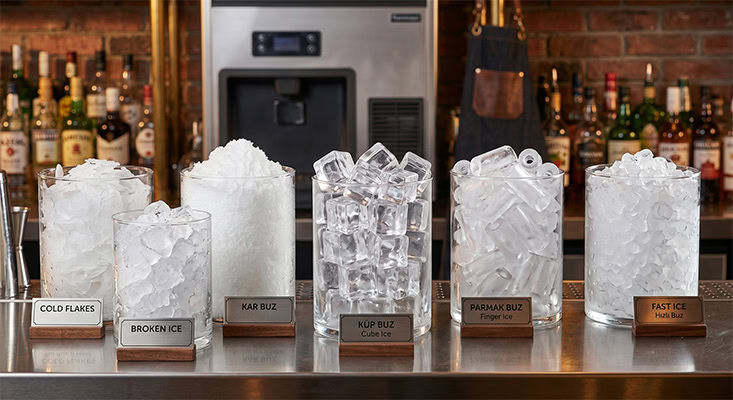
Ice Finger ice cubes stand out for their long, cylindrical shape. They have been developed specifically for fizzy drinks, cocktails and soft drinks served in tall glasses. Typically produced at around 20 grams, this type of ice cube quickly lowers the temperature of the drink thanks to its large size, whilst creating an aesthetic and stylish appearance in the glass. They deliver excellent results in beverage service scenarios where rapid cooling is required.
Fast Ice
Fast Ice cubes are designed for businesses requiring high production speeds. They are usually produced weighing approximately 7 grams. Their light weight increases the surface area in contact with the drink, enabling very rapid cooling. Their production times are shorter than those of Ice Cube and Ice Finger ice. For this reason, they are frequently preferred in fast-food restaurants, chain restaurants, self-service beverage areas and establishments with high customer footfall.
Ice Flakes (Granulated Ice)
Ice Flakes, also known as snow ice or granular ice, are one of the most popular types of ice in the catering industry. Thanks to their small and soft structure, they can completely envelop products. They are used extensively at open buffets, in seafood displays, for table service and in self-service areas. The fact that they are easy to portion provides businesses with ease of use whilst creating a highly aesthetic and professional appearance in product presentations. Brema flake ice machines, available in various production capacities, will meet your needs in this regard.
Cold Flakes
Cold Flakes are a type of ice produced in a thin, flake-like form, typically 1–2 mm thick, with a high surface area. They are frequently used for the preservation of vegetables, fruit, seafood and delicate food products. By completely covering the product’s surface, it accelerates heat transfer and helps products stay fresh for longer. It offers significant advantages in terms of both preservation and visual presentation, particularly in food display units. Thanks to its fine and lightweight structure, it provides effective cooling without damaging the products, whilst reducing moisture loss to help preserve their natural appearance and quality.
Broken Ice
Broken ice is considered a coarser version of granular ice. It is generally produced in thicknesses ranging from 1.5 mm to 3 mm and can provide effective cooling on products at temperatures between -5°C and -10°C. Its most common application is in the fishing industry. However, its use is not limited to this sector. It is also used extensively for temperature control in dairy production, meat processing plants, bread production and the chemical industry. Thanks to its structure, which can completely envelop the product, it contributes to long-term preservation and the extension of the product’s shelf life.
The Importance and Functions of Filtration Systems
Advanced filtration systems used in industrial ice machines filter out sediment, chlorine, minerals that cause limescale formation, and other foreign particles that may be present in the water, thereby both improving the quality of the ice produced and protecting the machine’s internal components. Water quality varies from region to region; water hardness, limescale content and mineral concentration can differ regionally. As these variations directly affect the performance, energy consumption and maintenance requirements of ice machines, it is of great importance in professional applications to select specialised filtration systems suited to the intended use and water analysis. With the right filtration solution, limescale and sediment build-up that may form over time in the evaporator, water distribution system, pumps and water lines are significantly reduced, ensuring that system performance is maintained over the long term.
High-quality filtration systems minimise deposits that may form on ice production surfaces, whilst contributing to more efficient operation of the equipment and optimised energy consumption. As a result, production capacity is maintained, the risk of breakdowns is reduced, and the system demonstrates more stable operational performance. Furthermore, the effective use of filtration technologies helps to extend maintenance intervals; as the frequency of cleaning, servicing and component replacement decreases, operational downtime is also minimised. Combined with regular filter maintenance and the timely replacement of filter elements, the critical components of the ice machine are protected, the equipment’s service life is extended, and businesses achieve higher operational efficiency at lower maintenance costs.
The Importance of the Sprayer System in Choosing an Ice Machine
One of the most important technologies in ice machines is the sprayer system. In this system, water is sprayed onto the evaporator surface at a specific pressure and with a specific distribution to facilitate ice formation. Thanks to sprayer technology, the water is distributed evenly across the evaporator, resulting in the production of clearer, harder and higher-quality ice.
These high-quality sprayer systems, which are not found in every ice machine, reduce water consumption whilst ensuring the ice forms in uniform sizes. They also help to keep limescale under control and enhance the machine’s overall performance. When evaluating professional ice machines, attention should be paid not only to daily production capacity but also to the sprayer technology used.
Semi-Hermetic Compressors, Automatic Water Control and Self-Cleaning Technology in Industrial Ice Machines
Semi-hermetic compressors used in industrial ice machines support uninterrupted ice production by offering high performance, energy efficiency and a long service life. They are generally preferred in high-capacity models. Thanks to their openable housing design, maintenance and servicing can be carried out more easily, which helps to reduce operating costs and extend the equipment’s lifespan. With their powerful cooling capacity, semi-hermetic compressors ensure the system operates stably, delivering reliable performance even under intensive operating conditions. Furthermore, the automatic water control systems found in industrial ice machines continuously monitor water levels and flow to maintain optimal production conditions, optimise water consumption and ensure consistent ice quality. Furthermore, the self-cleaning function included in some models helps to automatically remove limescale, sediment and dirt build-up from the ice production surfaces and water circuits at regular intervals, thereby supporting the maintenance of hygiene standards. The combined use of these technologies ensures more efficient operation, lower operating costs and reliable performance for many years to come
The Importance of Using the Right Ice Machine in the Right Place
An ice machine should not be selected based on capacity alone. In commercial settings, choosing the right type of ice for the correct application is of great importance in terms of efficiency, presentation quality and product performance. Cube ice offers an ideal solution for serving drinks in restaurants, bars and hotels thanks to its slow-melting properties, whilst flake ice is preferred for buffet presentations, food displays and the healthcare sector due to its malleable structure. Cold Flakes, with their large surface area, help preserve the freshness of fish, seafood, meat and fresh produce. Ice Finger, with its structure designed to rapidly chill drinks, is particularly well-suited to cafés, fast-food outlets and self-service beverage areas. Fast Ice meets the need for rapid cooling in high-volume establishments, thereby enhancing operational efficiency; crushed ice, meanwhile, offers both aesthetic and functional benefits in cocktail preparation, smoothie production, seafood presentation and specialised food displays. Using the right type of ice in the right setting optimises operational costs whilst maximising customer satisfaction.
With its many years of experience in the sector, durable, quiet and energy-efficient systems, high-quality production standards and a wide product range, Brema ranks among the world’s most reliable brands for professional ice machine solutions. Consequently, it continues to enhance business efficiency and product quality by offering user-friendly ice production solutions tailored to the needs of various sectors.